The 2026 Biosimilars Market: Where the $67 Billion Is Actually Going
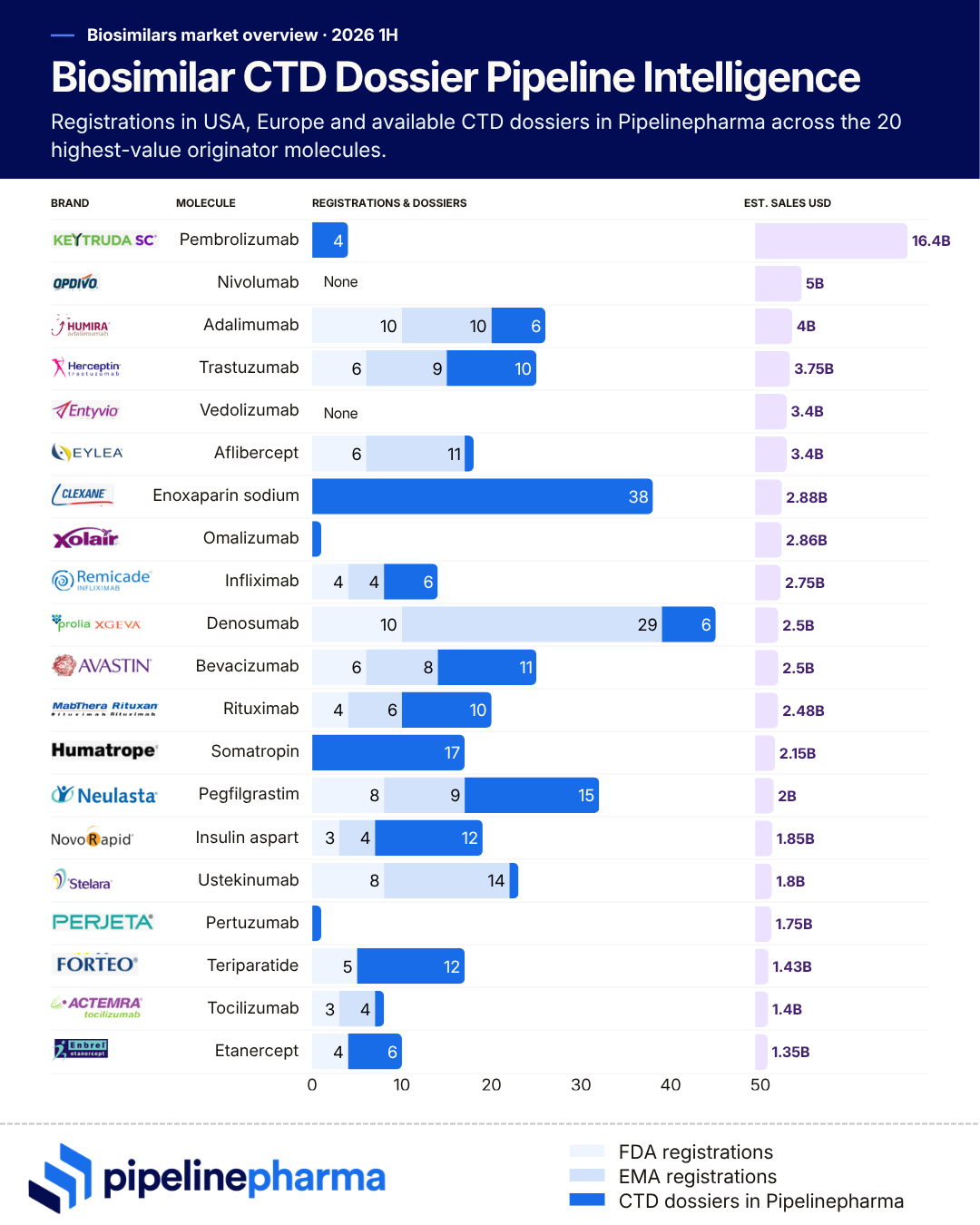
Every year, biosimilars get talked about as a single story: patents expire, prices fall, competition arrives. Our 2026 first-half review of the 20 highest-value originator molecules worldwide tells a more complicated story - and a more useful one for anyone making sourcing, pipeline or market-entry decisions right now.
Across these 20 molecules, combined worldwide sales reached roughly $67 billion in just the first six months of 2026. But that figure hides three very different markets sitting side by side: blockbusters where biosimilar competition hasn't arrived yet, molecules where it has already reshaped the entire category, and a middle group still in the early stages of erosion.
The giants still waiting for competition
Two of the three largest biologics in the world - Keytruda (pembrolizumab, $16.4B in H1 2026) and Opdivo (nivolumab, $5.1B) - still have zero approved biosimilars in the US or EU. That's not for lack of trying: at least 9 biosimilar programs are in development against Keytruda alone, including Formycon, Samsung Bioepis, Amgen, Sandoz, Celltrion and several Chinese developers. Core patents on both molecules run to roughly 2028, with secondary formulation patents on Keytruda's subcutaneous version potentially extending exclusivity further, into the mid-2030s.
Entyvio (vedolizumab, $3.4B) sits just behind them: two biosimilar applications - from Polpharma/Fresenius Kabi and Alvotech/Teva — were accepted for FDA review in 2026, with first approvals plausible in 2027, though Takeda itself now guides toward US biosimilar entry closer to 2029-2031.
For companies tracking entry timing, these three molecules represent the next wave rather than the current one - and the pipeline behind them is already crowded.
The molecules biosimilars have already reshaped
At the other end, several markets are effectively post-competition. Enoxaparin sodium (Lovenox/Clexane) has the most CTD dossiers of any molecule in our database - 38 - reflecting how thoroughly genericized this anticoagulant has become, even though it never went through a formal biosimilar pathway in the US. Sanofi has cited biosimilar and generic pressure directly in its ~19% year-on-year revenue decline for the molecule.
Ustekinumab (Stelara) is probably the clearest erosion story in the dataset: the originator fell from roughly $3.28B in H1 2025 to $1.40B in H1 2026 - nearly halved in a single year - as 8 FDA-approved and 14 EMA-approved biosimilars entered the market.
Humira (adalimumab), Avastin (bevacizumab) and Rituxan (rituximab) tell a similar story at a more mature stage: each now has 10+ combined US/EU biosimilar approvals, each originator has become a minority player in its own molecule class, and in Humira's case, sales are down an estimated 37% year-on-year.
Denosumab (Prolia/Xgeva) is a special case worth flagging for anyone building competitive counts: it shows 10 unique FDA approvals but around 29 EMA entries, because EU biosimilars are often marketed under twin brand names while the FDA counts unique BLAs. The same underlying competitive intensity can look very different depending on which counting convention a source uses.
The middle ground: recent entrants still ramping
A third group has biosimilars on the market, but not long enough for the effect to fully show up in revenue. Aflibercept (Eylea) biosimilars only launched in the EU in May 2026, and are contractually blocked from the US market until 2027 under Regeneron's settlement agreements. Omalizumab (Xolair) shows the split clearly: Novartis's ex-US business is down ~19% as EU biosimilars bite, while Roche's US/Japan book is still growing, since its US biosimilar launched in 2025 but hasn't reached material volume yet.
Golimumab (Simponi) is the newest entrant in the set - its first US biosimilar was approved in May 2026, with launch expected in Q4 2026 - while Etanercept (Enbrel) shows the opposite pattern: biosimilars are approved in both the US and EU, but a patent upheld by the Federal Circuit blocks US launch until 2029, even as EU erosion is already reflected in Pfizer's declining ex-US figures.
Why this matters beyond the headline number
The pattern across all 20 molecules is the same: the interesting decisions live in the timing gap, not in the binary of "has a biosimilar or doesn't." A molecule with approved biosimilars can still be commercially unaffected for years if patents block launch (Enbrel, Eylea in the US). A molecule with no approved biosimilar can still be one settlement or one FDA decision away from a step change (Keytruda's 12-year exclusivity period itself lapsed in September 2026). And the same competitive count can look crowded or sparse depending on whether you're counting unique approvals or marketed brand names.
This is exactly the kind of detail that gets lost in headline "biosimilars market size" figures, and exactly what sourcing, business development and market access teams need at the molecule level to time their own moves.
About this data
This overview covers the 20 highest-value originator molecules by worldwide revenue, plus the three largest upcoming biosimilar targets not yet approved anywhere. Figures are compiled from FDA and EMA regulatory trackers, company Q1/Q2 2026 earnings releases and SEC filings, and credible market-research estimates as of 2 September 2026 - full source notes and confidence ratings are available on request. Biosimilar-specific dollar figures are estimates in most cases, since no public source publishes total biosimilar revenue by molecule and quarter; where our confidence in a figure is low, we recommend verifying against a paid data provider before using it in external or investor-facing materials.
Pipelinepharma maintains CTD dossier availability, registration status and patent/exclusivity timelines across this full set of molecules - and continues to expand coverage as new biosimilars enter development, review and launch.