Part 2: Generic Pipeline Intelligence vs Innovator Pipeline Intelligence - Where the Strategic Pillars Intersect
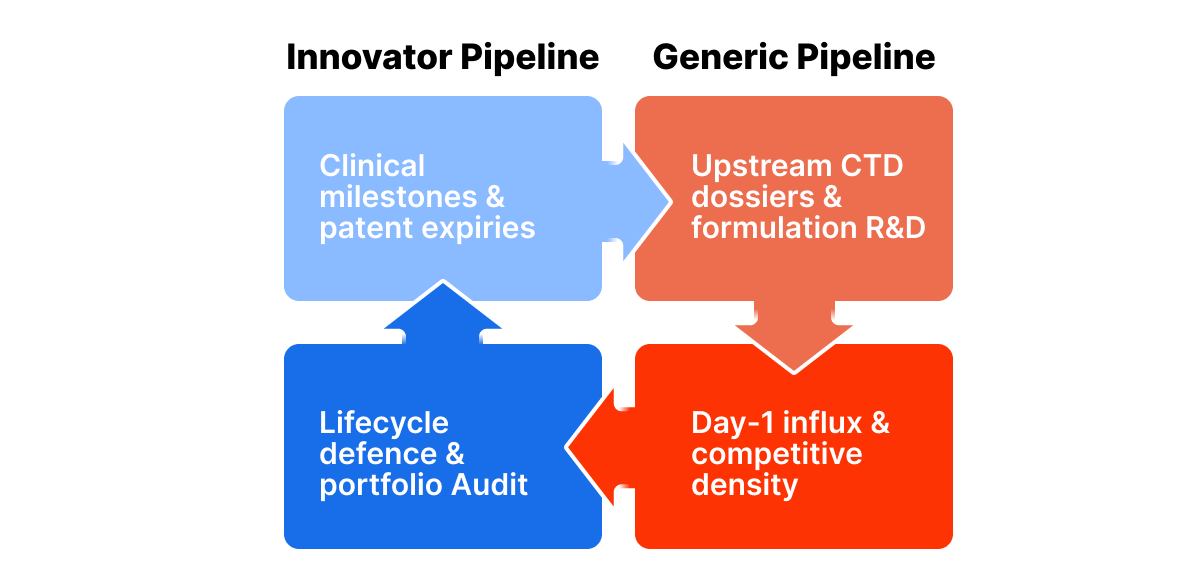
Innovative clinical progress and the hidden development of generic dossiers do not operate in separate silos. They are two sides of the same commercial coin. A clinical shift in the innovator pipeline (Pillar 1) immediately alters generic R&D investment timelines, while hidden development milestones within the generic dossier layer (Pillar 2) directly dictate the terminal value of the innovator asset.
1. What Innovative Decision-Makers Must Track in the Generic Pipeline Intelligence
If an originator company has a blockbuster drug facing patent expiration in 5 to 7 years, relying on traditional commercial databases creates a dangerous corporate illusion. Executives must audit the hidden generic dossier layer to execute three critical workflows:
- Accurate Loss of Exclusivity (LOE) Forecasting: Originators must gauge the exact volume and readiness of the generic wave preparing behind their patent wall. By monitoring the speed, regulatory zones, and volume of emerging CTD dossiers, they can accurately anticipate the Day-1 and First-Year Generic Influx.
- Defensive Pricing and Budgeting: Knowing in advance whether 2 or more than 10 generic competitors will launch during the first 12 months allows the C-suite to mathematically forecast price erosion and market share loss. This prevents over-optimistic budgeting and protects shareholder value.
- Precision Lifecycle Management: Concrete evidence of generic dossier maturity tells the originator exactly when to launch line extensions, execute reformulations, or transition patients to newer-generation patent assets before the legacy asset's margins collapse.
2. What Generic Decision-Makers Must Track in the Innovator Pipeline Intelligence
Conversely, generic, biosimilar, and out-licensing executives cannot build a profitable portfolio in a vacuum. To secure a high return on investment, they must continuously cross-reference innovator intelligence:
- Patent Cluster & Loophole Analysis: Innovators wrap molecules in complex webs of secondary patents (formulation, crystalline forms, methods of use). Generic intelligence must map these clusters to find the true legal window of entry or paths for successful litigation.
- Clinical Trial Expansions: Tracking whether an innovator is running new clinical trials for pediatric extensions or secondary indications is critical. A successful trial can grant the originator regulatory exclusivity extensions, artificially pushing back the generic launch date and rendering early R&D investments obsolete if not tracked in real-time.
The High Cost of Corporate Blind Spots
Operating with only half of the Pipeline Intelligence equation leads to severe strategic errors for both corporate types, often resulting in massive financial losses.
For Innovators: The Cost of Ignoring Pillar 2
An originator company might assume they have a secure, predictable revenue stream until the exact day of patent expiry. However, if they fail to monitor the hidden generic dossier layer, they remain blind to the "Red Ocean" forming behind the scenes.
If 15 generic developers are secretly holding ready-to-file dossiers, the originator will face an immediate, catastrophic 90% price erosion within the first few weeks of market exposure. Failing to anticipate this volume results in missed windows for lifecycle extensions, faulty long-term revenue projections given to the board, and the rapid destruction of enterprise value.
For Generics: The Cost of Ignoring Pillar 1 (And the New Reality of Pillar 2)
While the pharmaceutical industry has mastered Pillar 1 (Innovator Intelligence) over decades, Pillar 2 (Generic Pipeline Intelligence) is a newly emerging discipline. Consequently, many generic companies are still blind to the massive competitive intelligence advantages it offers, leading them to execute high-risk strategies based on incomplete information.
To build a bulletproof portfolio, a generic developer must master the intersection of both pillars:
- The Trap of Overlooking Pillar 1: A generic developer might identify a highly lucrative, off-patent blockbuster and invest heavy capital into bioequivalence trials and dossier creation. But if they are blind to the innovator pipeline, they might miss that the originator is successfully running Phase III trials to transition the entire clinical market to a superior, long-acting formulation or a fixed-dose combination. By the time the generic dossier is ready to file, the original product market has been completely cannibalized, leaving the generic company with an expensive, non-viable dossier for an obsolete drug.
- The Power of Deploying Pillar 2: Conversely, by embracing the newly introduced capabilities of Pillar 2, generic companies can actively shift their commercial strategies from reactive guessing to predictive validation. Combining Pillar 1 (knowing when the patent wall crumbles) with Pillar 2 (knowing exactly how many secret dossiers are ready to breach that wall) transforms risk assessment. It empowers Business Development and Portfolio managers to walk away from overcrowded "Red Oceans", negotiate aggressive discounts on inbound dossiers based on real global supply volumes, and confidently redirect limited R&D capital into genuine, zero-competition "White Spot" opportunities.
Conclusion: 360-Degree Vision for Enterprise Value
Pipeline Intelligence is no longer a static, single-pillar discipline focused solely on tracking clinical trials for new molecules. While the industry has long mastered the public frontier of innovator tracking, true pharmaceutical leadership now requires a 360-degree matrix that actively fuses public clinical milestones with the newly emerging discipline of hidden, upstream generic dossier tracking.
Whether you are an innovative CEO seeking to defend a multi-billion-dollar franchise from an unseen generic influx, or a generic executive shifting strategy to capture an untouched, zero-competition "White Spot" opportunity, your strategic ROI depends entirely on dual-pillar visibility.
As the creator of the industry's first dedicated CTD database, Pipelinepharma bridges this critical information gap, providing unprecedented visibility into 93,000+ global dossiers from over 2,000 manufacturing partners. By removing the traditional blind spot of the pre-launch generic layer, modern pharmaceutical companies can transition from reactive market participation to predictive, data-backed global governance.