The Hidden Cost of a Bad Pharma Portfolio Decision
A pharmaceutical company rarely loses money on a “bad product” because the molecule itself is technically flawed. More often, the financial damage starts much earlier - when a product enters the pipeline based on an incomplete, retrospective understanding of its future competitive landscape.
A finished dosage form (FDF) may be chemically sound, the Common Technical Document (CTD) dossier may be perfectly approvable, and the manufacturing facility may hold pristine Good Manufacturing Practice (GMP) credentials. Yet, the asset can still become a value-destroying deficit if dozens of parallel competitors launch identical versions simultaneously, driving steep post-patent market price erosion before you even clear local registration.
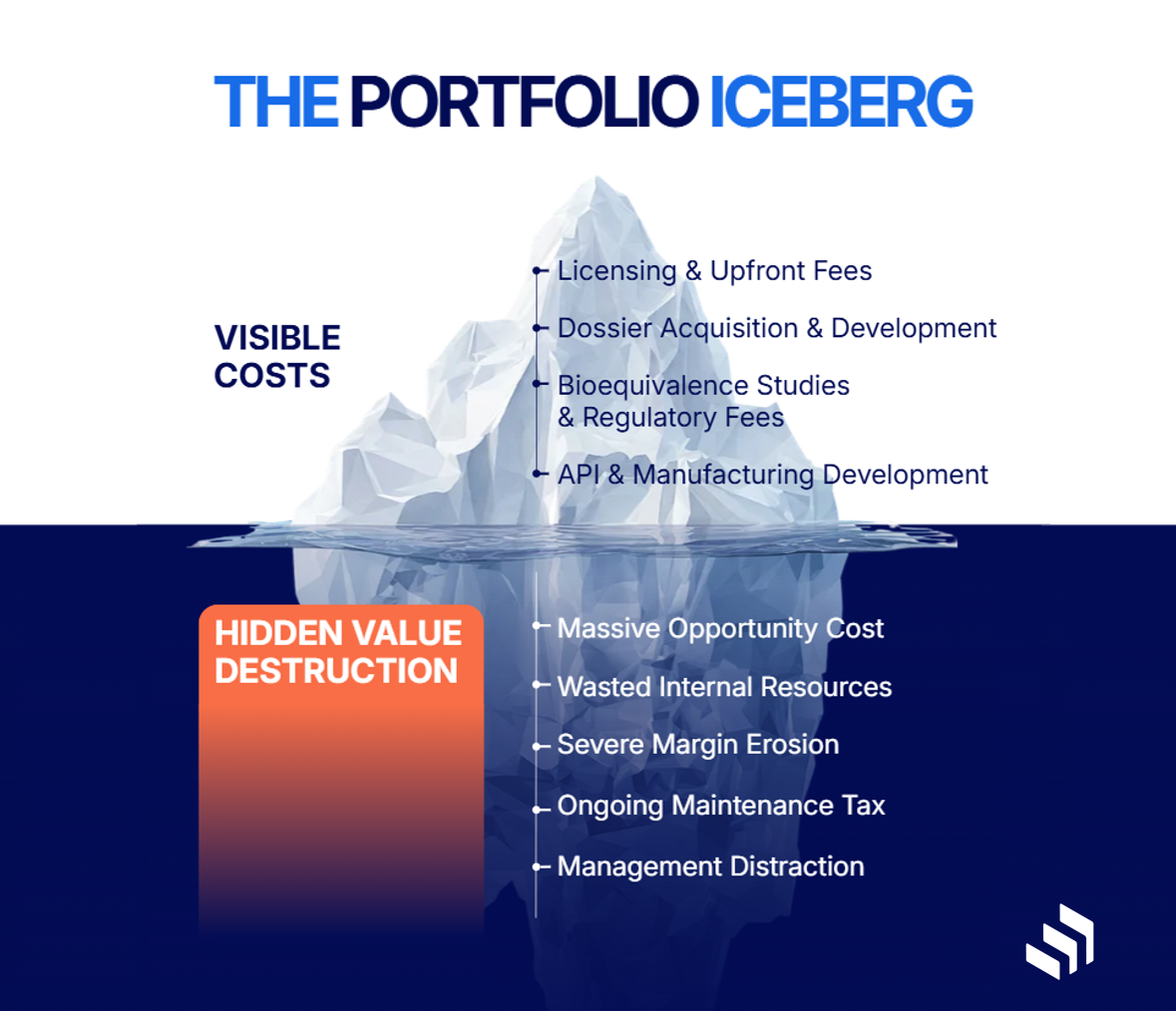
The Portfolio Iceberg: The Real Cost of an Asset
When a business development team decides to internally develop or in-license a generic medicine, they typically build forecasts around the visible expenses. However, the true financial exposure functions like an iceberg, where the most dangerous liabilities sit below the surface.
| Visible costs | Less visible costs |
|---|---|
| Licensing and upfront payments | Internal RA, QA, BD and technical resources |
| Dossier acquisition or development | Management time |
| Regulatory fees | Opportunity cost |
| Bioequivalence studies | Delayed development of alternative products |
| Technology transfer | Manufacturing capacity occupied by low-value projects |
| API and manufacturing development | Additional regulatory and quality workload |
| Validation batches | Commercial resources allocated to an underperforming product |
| Launch preparation | Ongoing maintenance of an asset with limited commercial return |
| Potential write-offs if the project is discontinued | |
| Margin erosion if the product is launched into an overcrowded market |
- Sunk Corporate Capital: If a project is abandoned late due to sudden market saturation, you lose far more than the upfront dossier price. The true loss includes hundreds of thousands of euros burned on technology transfer, validation batches, and dedicated regulatory labor.
- Severe Opportunity Cost: This is often one of the most underestimated costs. While regulatory, technical, commercial, and business development teams are working on a product with limited commercial potential, those resources cannot be fully dedicated to alternative products with stronger commercial potential.
- The Saturated Launch Trap: Once significant budgets are deployed, corporate inertia often pushes companies to launch an underperforming product anyway, just to recoup a fraction of the cost. In reality, a highly commoditized generic can generate surface-level revenue while actively destroying value through ongoing distribution, pharmacovigilance (PV), and mandatory dossier maintenance overhead.
The Dangerous Blind Spot of Historical Data
Traditional portfolio evaluation relies heavily on retrospective market data: current market size, historical pricing, existing competitors, and current demand. But for a generic product that will reach the market years later, looking at past data is a critical strategic error.
Official empirical evidence from a comprehensive US Food and Drug Administration (FDA) generic competition report proves the velocity of value destruction in generic markets. The data indicates that while one or two initial competitors cause moderate price adjustments, the entry of additional players accelerates deflation exponentially. Specifically, when six or more generic manufacturers enter a market, average manufacturer prices drop by more than 95% compared to the original brand price.
Relying strictly on national health authority registries only shows you who has already crossed the finish line. It completely misses the unlaunched pipeline layer - the dozens of alternative manufacturers holding "Ready to File" eCTD modules behind closed factory doors, preparing to execute a simultaneous Day 1 generic launch.
De-risking Investments via Predictive Pipeline Intelligence
To protect corporate capital, C-level executives and portfolio directors must shift from historical auditing to predictive pipeline intelligence. Integrating live, permission-based manufacturing data allows commercial teams to stress-test their asset allocations before signing binding agreements.
By leveraging centralized B2B platforms like Pipelinepharma, sourcing managers can instantly investigate the competitive environment and understand how many potential suppliers, dossiers, and competing development activities already exist.
The cost of discovering that a market is oversaturated is highest after you have spent years in development. Early visibility gives your company the leverage to change direction while there is still time - either by skipping an overcrowded space entirely, or compressing time-to-market by joining an existing development or in-licensing a completed dossier instead of starting the project from scratch